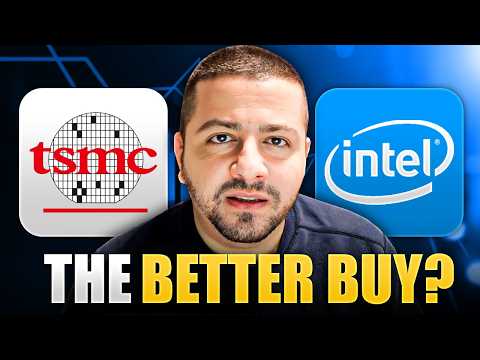
Should Semiconductor Stock Investors Buy Intel Stock Instead of Taiwan Semiconductor Stock?
2 extracted signals · 0 resolved · 2 still active
 Parkev Tatevosian, CFAIndependent analyst profile
- Source published
- 04 Jul 2026, 11:45 UTC
- Recorded by Tahlil Plus
- 04 Jul 2026, 11:49 UTC
AI-generated source summary
The analysis compares Taiwan Semiconductor Manufacturing Company (TSM) and Intel (INTC) based on their financial performance over the past decade. TSM has shown significant revenue growth, doubling its revenue from approximately \$30 billion in 2017 to \$133 billion in the trailing twelve months, while Intel's revenue has declined from \$65 billion to \$53.76 billion over the same period. TSM's operating margin has remained strong, peaking at 53.18%, whereas Intel's operating margin has fallen to 2.47%. TSM's CAPEX to Revenue ratio is currently 0.327, indicating substantial investment in its manufacturing capabilities, while Intel's ratio is 0.244, suggesting a more conservative approach. TSM's forward P/E ratio is 28.14, significantly lower than Intel's 116.79, indicating TSM is trading at a lower valuation relative to its earnings. The analysis suggests that TSM is undervalued, with a calculated intrinsic value per share of \$628.42 compared to its market price of \$449.46. Conversely, Intel is perceived as overvalued, with its intrinsic value per share estimated at \$49.88 against a market price of \$128.37. Geopolitical factors, particularly the tensions between China and Taiwan, are highlighted as a potential risk for TSM, which is expanding its manufacturing facilities globally. However, the analysis concludes that TSM's strong fundamentals and favorable valuation make it a more attractive investment than Intel, despite the geopolitical uncertainties.
AI-generated summary based on the source content.
Signal outcomes at a glance
Tracking LiveSignals in this source
Evidence and evaluation progress
- Original source published
The analyst published the original source item.
- Source recorded by Tahlil Plus
The public source was preserved as the evidence record for this case.
- Market predictions extracted
2 eligible signals linked to this case.
- Source processing completed
Source analysis and structured extraction completed.
- Outcome tracking started
Tahlil Plus began monitoring the extracted predictions.
- Live evaluation in progress
2 signals remain active.
Parkev Tatevosian, CFA
Platform-wide history, separate from this source evaluation.
Tahlil Plus independently records and evaluates public market predictions. Extraction may be AI-assisted and results follow the Tahlil Plus methodology. This information is not financial advice.